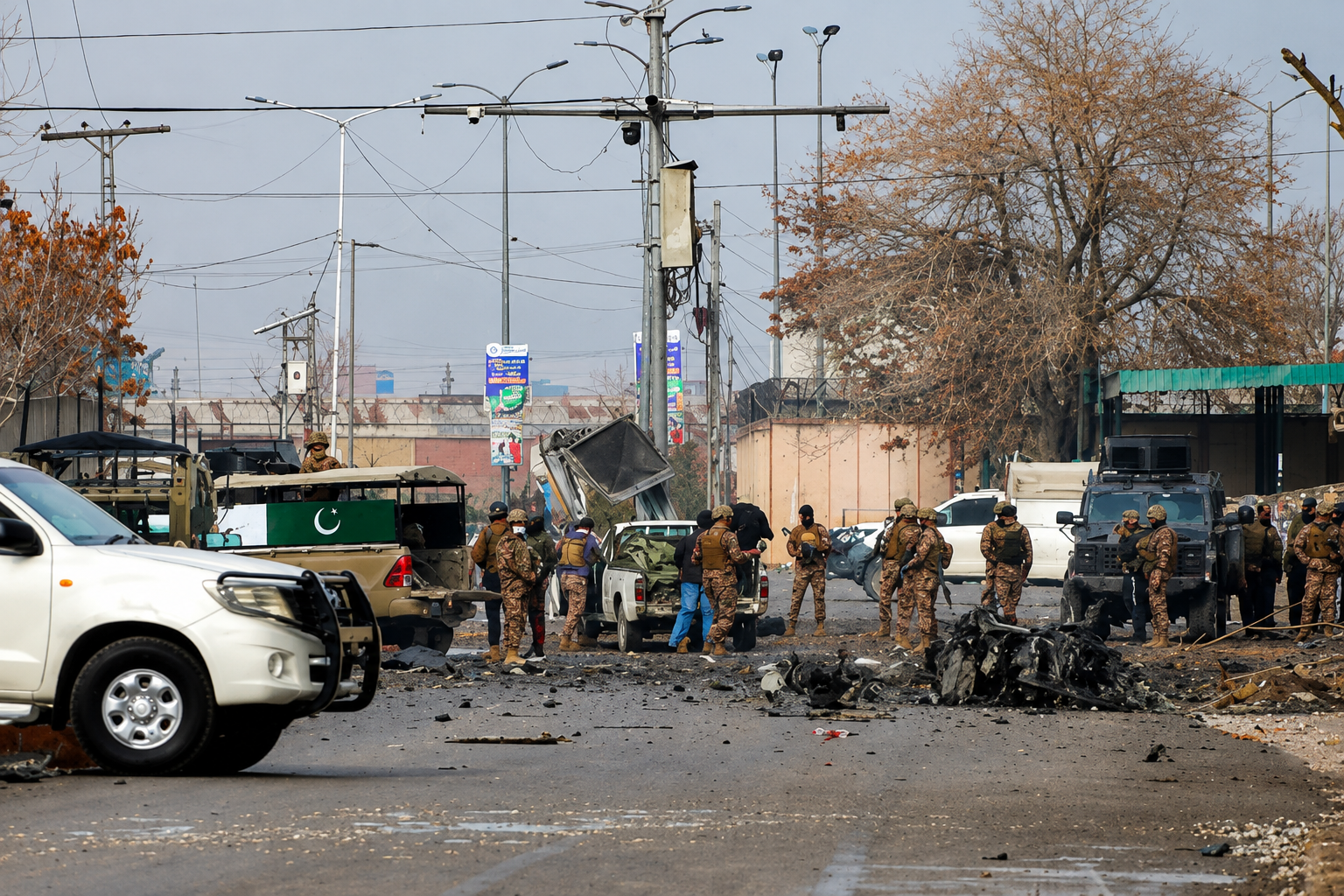
In the days prior to 14th of August, a particular headline appeared on almost all the Fourth Estate’s covers. DAWN, the Business Recorder and the Express Tribune all carried some variation of the headline ‘18 terrorists killed in VBIED explosion, security operation in Balochistan’, almost invariably with a subheading noting that (as per ISPR) three civilians had died due to a ‘secondary explosion’.
This is Operation Azm-e-Istehkam, the ongoing counter-insurgency operation launched by the Government in June 2024. Within the past year, one would be hard pressed to find two consecutive copies of DAWN that do not somewhere make mention of a certain number of ‘terrorists’ being killed by the forces. ISPR increasingly uses, in its statements, highly politicised terms such as ‘sanitisation’ and ‘ high-tempo clean-up operations’ directed at ‘Khwarij’ and ‘Fitna-al-Hindustan’.
At its launch, it was lauded by the US State Department through Spokesperson Matt Miller, who noted that"we support Pakistan’s efforts to combat terrorism and ensure the safety and security of its citizens in a manner that promotes the rule of law and protection of human rights”. Rights organisation in Pakistan and abroad raised concerns, with HRCP expressing concerns about the “potentially adverse impact this measure could have on ordinary citizens, many of whom include families who were displaced by earlier security operations and have yet to be compensated or rehabilitated.”
2 years later, with increasingly frequent operations, The Pakistani Press, for the most part, seems to report only the statement from ISPR. As reproduced in full by the Tribune without comment, the ISPR had this to say regarding the events in Surab; “The premature detonation during preparation resulted in the confirmed killing of eight terrorists, with multiple others injured. However, the blast and secondary detonation of other explosives stored there by the terrorists of Indian proxy have also reportedly caused tragic casualties among three nearby civilians.” The claim of a ‘secondary explosion’, presumably a supposed stockpile of ammunition has raised eye-brows as; notably similar to the line often deployed by the IDF.
If the locals of Surab are asked what happened last week, accounts invariably hold that there was no vehicular bomb being prepared and that the deaths resulted due to an airstrike by the Pakistani military and that the majority of the casualties were children. Photos have emerged of dead and wounded children; a father covered in dust holding his shell-shocked baby, a dead toddler appearing in blissful and final slumber. Jamal Baloch (jamal_baloch on instagram) reported that the death toll had reached 27, mostly children, and later that the families of the dead had taken the bodies to Sooran Mian Chowk in Gadar Gondan in protest. A week later, the event has seemingly faded from the nation’s mind.
Since then, there have been more ‘intelligence-based operations’ leading to the deaths of dozens of people, with 49 ‘terrorists’ killed on the 21st of August as per ISPR . There is little information about what criteria the forces employ to determine who is a terrorist and what the operational criteria is for killing versus capturing alleged terrorists.
After the Surab incident, the Tribune reported that“the prime minister said the fight against terrorism would continue until the complete elimination of the menace from the country”. This begs the question; the ‘complete elimination’ of who, exactly? The operating standpoint of the administration seems currently to be based on pure force alone. It is worth reflecting on what history has taught us about the use of bare force to deal with insurgencies.