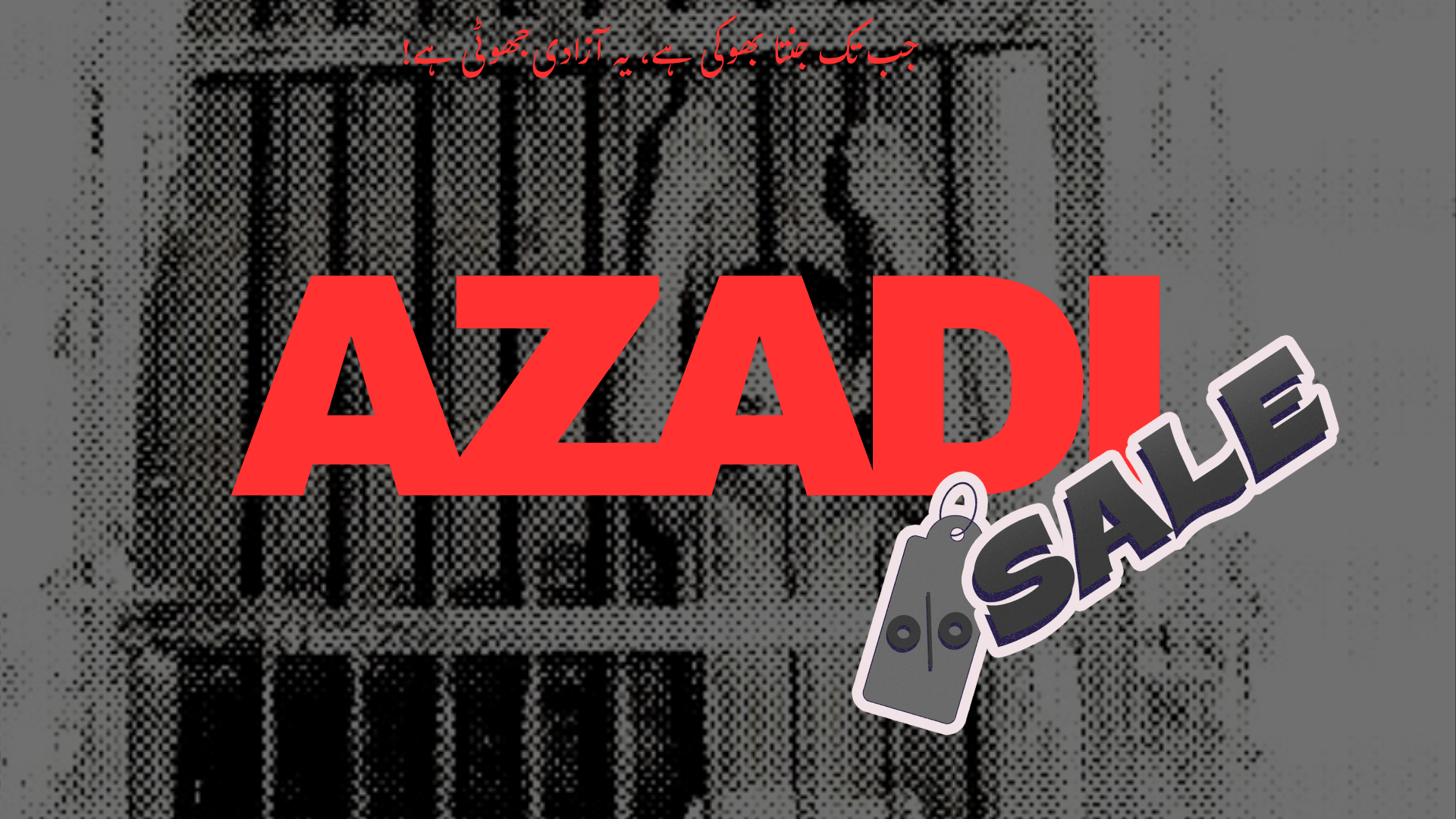
Every August, Pakistan starts selling independence. Clothes, shoes, phones, restaurants, furniture, cosmetics, almost everything suddenly acquires a green-and-white banner. Azadi Sale. 14 August Special. Flat 50% Off. Shopping malls put up crescents and stars, brands change their logos, and songs about Pakistan begin playing everywhere. There is something strangely fitting about the phrase Azadi Sale. We have managed to turn freedom into something that can be bought. But perhaps the more uncomfortable question is not why companies sell azadi, but what kind of azadi we are actually celebrating. On the evening of 14 August, Lahore will look different. Green lights will spill across buildings, children will have little flags tied to their wrists, families will crowd onto motorcycles and cars, roads will fill with horns and fireworks, and somewhere a cake will be cut with a green-and-white flag stuck into it. At the same time, a worker will be closing a shop after twelve hours because he cannot afford to lose a day's wages. Both are living in the same Pakistan. And that is where the celebration begins to feel strange.
We talk about freedom as though it belongs equally to everyone simply because we possess a Pakistani passport. But rights are not experienced through passports. They are experienced through the workplace, the police station, the courtroom, the price of electricity, the cost of food, the availability of healthcare and, sometimes, through the simple question of whether you can speak against power without fearing what comes next. Pakistan's 2024-25 Labour Force Survey found that 80.8 percent of employed workers were in informal employment, leaving millions without the protections associated with formal work. For a labourer in Lahore, freedom can mean something very different from what it means to someone sitting in an air-conditioned office. If your income depends on working another twelve hours tomorrow, if missing one day means missing dinner, how meaningful is the theoretical freedom to leave your job? The same contradiction appears in poverty. The World Bank estimates that 22.5 percent of Pakistan's population lived below the national poverty line in FY2025. These are not just economic statistics. They describe the limits placed on people's choices before they ever enter a courtroom or a polling booth. A person struggling to pay rent, electricity and food is formally a citizen with rights, but materially has far less room to exercise them.
And then there are rights that are not simply difficult to exercise but are actively threatened. In 2024, the Human Rights Commission of Pakistan recorded 379 new cases of enforced disappearance, alongside thousands of reported police encounters in Punjab and Sindh. Behind every disappearance is a family that has to live with an unanswered question. This is where the story of Mahrang Baloch becomes impossible to separate from the wider question of freedom. Her politics emerged from the demand for answers about enforced disappearances and violence in Balochistan, yet her movement itself has repeatedly been dealt with through arrests and anti-terrorism legislation. In 2026, she was sentenced to life imprisonment by an Anti-Terrorism Court, a decision condemned by UN experts. The cases of Imaan Mazari and Hadi Ali Chattha raise a similar question from another direction. Both lawyers have worked on human-rights issues and criticised powerful institutions. In January 2026 they received prison sentences over social-media posts, with Amnesty International describing their prosecution as part of a wider pattern of judicial harassment. At some point, the language changes. A person
demanding answers becomes a security concern. A protest becomes a threat. A lawyer's criticism becomes a cybercrime case. The right to speak still exists on paper, but exercising it begins to carry a price that ordinary people may not be able to pay.
Kashmir exposes this contradiction even more sharply. Pakistan has spent decades speaking about Kashmir through the language of self-determination, arguing that Kashmiris should have a meaningful say over their political future. Yet this year, Pakistan-administered Kashmir itself saw deadly protests over political and economic grievances, including the controversial twelve refugee seats in the AJK Assembly. The Joint Awami Action Committee argued that people living outside the territory should not determine its internal political representation. The movement was banned under anti-terrorism legislation, communications were disrupted and clashes between protesters and security forces left dozens dead according to competing accounts. Whatever final figure is established, the underlying contradiction remains: people were protesting over the conditions under which they were governed, and the dispute became a security crisis. This is not to suggest that Pakistan and India exercise identical forms of control in Kashmir; they do not. It is to ask why a state that invokes self-determination so consistently in relation to Kashmir becomes uncomfortable when Kashmiris on its own side of the Line of Control challenge their political arrangements. The deeper problem is that Pakistan inherited a colonial state whose institutions were designed to administer and control a population, and successive governments and security institutions strengthened that relationship rather than fundamentally transforming it. The British left in 1947, but the experience of the citizen confronting a powerful, distant state did not simply disappear with them. It survived in different forms through policing, bureaucracy, emergency laws, militarisation and the growing role of security institutions in political life.
That is why Azadi Sale feels more revealing than it was ever intended to be. The market can sell the appearance of freedom very easily. It can put a crescent on a billboard, turn the flag into a logo, offer a discount and call it independence. But it cannot give a worker bargaining power. It cannot return a disappeared person. It cannot make a Baloch family whole. It cannot give a Kashmiri meaningful political representation. It cannot make a lawyer safe for criticising power, or give a student the right to organise. Those are political and material questions, not consumer choices. Perhaps this is what we should mean when we talk about azadi: not simply the freedom to wave a flag, buy something during a sale or celebrate a historical event that happened seventy-nine years ago, but the ability of ordinary people to exercise power over the conditions of their own lives. A worker needs the power to negotiate. A family needs the right to demand answers. A student needs the freedom to organise. A lawyer needs to be able to represent unpopular people without becoming a target. A Kashmiri needs to be able to challenge their political system without the question immediately becoming a security operation. The British left in 1947; that was independence from colonial rule. But political and economic freedom was never completed in a single day. Perhaps the question this 14 August is therefore not whether Pakistan is free. It is: free for whom?
Opinion
Azadi Sale: What Are We Really Celebrating on Independence Day?
Every August, Pakistan turns independence into a sale. But beneath the celebrations lies a harder question: what does freedom actually mean and who gets to experience it?